_edited.jpg)
What The Odyssey Teaches Us About Purpose

Updated: Aug 6

Like millions of moviegoers, I recently went and saw Christopher Nolan’s The Odyssey, and have been watching the global buzz unfold with great intrigue. Seeing Matt Damon portray the relentless grit and resilience of Odysseus on the big screen was an impressive spectacle I must say.
For me, however, this story hits far closer to home.
Growing up in a household steeped in Greek heritage, ancient mythology wasn't just something we'd watch on a screen, it was part of our living identity. Long before Nolan brought Homer’s epic to IMAX screens, my Father would sit by my bed and read me the tales of Odysseus. Through his voice, I didn't just hear an exciting bedtime story; I learned my first lessons about human resilience, sacrifice, honour, and the deep, magnetic pull of a greater purpose.

I learned that Zeus's Law asserts that civilisation and individual character are defined by how we treat each other, and a meaningful life is not built through self-absorption or hoarding resources, but through active engagement with the world beyond our immediate tribe. True purpose emerges when we bridge division and build trust with what is initially unfamiliar.
In the Greek language there's a magical word that cannot be translated into English; "philotimo" is a combination of friendship, hospitality, generosity, caring and treating each other with respect, because irrespective of our positions, we're all the same biological creatures doing our best to navigate life. You feel this philotimo when you visit Greece, particularly the islands and villages. The locals will invite you into their homes for a meal, they leave their doors unlocked and warmly treat everyone as family.
As hosts of our own lives, spaces, and leadership roles, our purpose includes creating psychological safety, using our emotional intelligence and cultivating unconditional positive regard for others. This involves extending trust and support without upfront conditions and expecting something in return, transforming our role from one of self-interest to one of genuine stewardship.
Decades later, as I watch The Odyssey unfold through the lens of Nolan's interpretation, I’m struck by another profound truth that writer Joseph Campbell identified in his work on the Hero’s Journey. Campbell dedicated his life to studying world mythologies, from ancient Greek epics to global folklore, and maintained that mythology isn't a myth but rather a representation of human psychology, biology and our lived experience.
The function of mythology is to harmonise and coordinate the energies in our body so that we will live a harmonious and fruitful life in accord with our society.
— Joseph Campbell
Campbell uncovered something profound: the Hero’s Journey is hardwired into our collective unconscious through the myths, ferry tales and stories passed down through the ages. Beneath every culture, era, and civilisation, the exact same critical elements and psychological blueprint for human transformation keeps appearing, and one that most people overlook when watching the film:
Odysseus wasn't the only man on those ships. He set sail from Troy after ten years with 12 ships and over 600 men. Yet, after another ten years of facing monsters, sirens, and brutal storms, he was the only one who made it home.
Why? It wasn't because Odysseus was physically invincible or immune to fear. It was because he possessed something his crew lost somewhere in the middle of the Aegean Sea: an unbreakable, non-negotiable clarity of purpose.
Our Modern Dilemma: "The Purpose Drift"
I consider it an honour to coach high-performers in my role as lead executive coach for The Open Mind Institute, ranging from CEOs, agency principals and founders, to senior leaders, these are people who have built impressive organisations and achieved remarkable success.
Yet, the most common friction point they bring into our sessions isn't a lack of talent or potential, it’s Purpose Drift.
They’ve crossed thresholds, fought their equivalent of the Cyclops (market downturns, scaling pressures, organisational shakeups), and survived, but somewhere along the way, their original 'why' grew blurry. Caught up in the minutiae of maintaining the status quo, they are left with a quiet void, feeling hollow and rudderless.
"He who has a why to live for can bear almost any how."
— Friedrich Nietzsche
This quote was famously popularised by neurologist and Holocaust survivor Viktor Frankl in his seminal book Man's Search for Meaning, where he used Nietzsche’s insight to explain how prisoners who maintained a deep sense of purpose (a "why") were far more resilient against unthinkable hardship.
When you haven't got clarity on your "why" (purpose), the Sirens win. Short-term distractions, instant gratification, comfortable shortcuts, and ego-driven pursuits start to dominate the mental landscape, which scratch the short-term itch but completely compromise reaching potential and fulfilling our deeper sense of purpose.
Odysseus’ crew didn't perish because the monsters were too big. They perished because, when the journey got brutal, they lost sight of Ithaca. Their purpose dissolved into mere survival mode.
Navigating the Purpose Journey: Purpose in 3 Stages
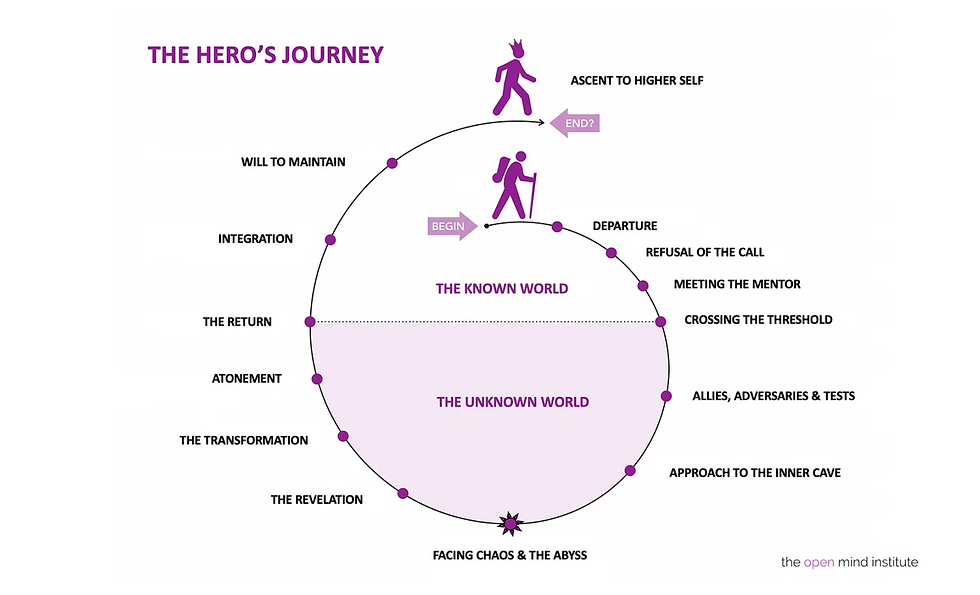
When we break down the Hero’s Journey, we look at how purpose acts as your internal compass across three pivotal phases:
1. Refusal of the Call
Every call to change disrupts our "ordinary world." For many of my clients, the call arrives as a plateau in business, a leadership crossroad, or a realisation that the old way of operating no longer serves who they are becoming. Our default position is often to refuse this call because it amounts to tremendous uncertainty. Purpose however, gives you the clarity to stop retreating to a comfortable past and empowers the move forward.
2. Facing Chaos (The Abyss)
The Cyclops in your life isn't a mythical beast; it’s facing your greatest fear and meeting the associated chaos from a position of acceptance (set-backs and suffering are an inevitability of life), and awareness (that facing our deepest fear and meeting our chaos will lead to a new creation); for it is these moments that forge our character, grit and resilience. When anchored in purpose, our brain reframes such obstacles as the exact conditioning required to expand into our purpose.
3. The Return (Identity & Service)
In ancient Greek, the root word for hero ("heros") translates to protector or servant. You don't conquer the journey just to collect a trophy. The ultimate goal of high performance is returning to your team, your business, and your family with heightened perspective, wisdom, and strength to give back, serving a purpose that is greater than you.
My Father understood this instinctively every time he shared those stories; that the journey only matters if it transforms who you are for the benefit of others.
What is Your Ithaca?
If you feel like you are currently navigating your own ten-year storm in business or life, take a step back from the daily firefights and ask yourself the foundational question we explore in our coaching room:
What is the home you are trying to get back to?
Not the title on your business card or the revenue target for next quarter, but the core purpose, values, and vision that make the relentless effort worthwhile.
If you want to dive deeper into how to find your purpose and map your own professional and personal odyssey, reach out to us here at The Open Mind Institute, our purpose is to help you achieve yours.
Paul Pitsaras LL.B B.Int.Bus. | Founder | Executive Coach |Speaker
The Open Mind Institute | 📞 1300 58 20 33 | 🌐 www.tomi.au | ✉️ paul@tomi.au



Comments